
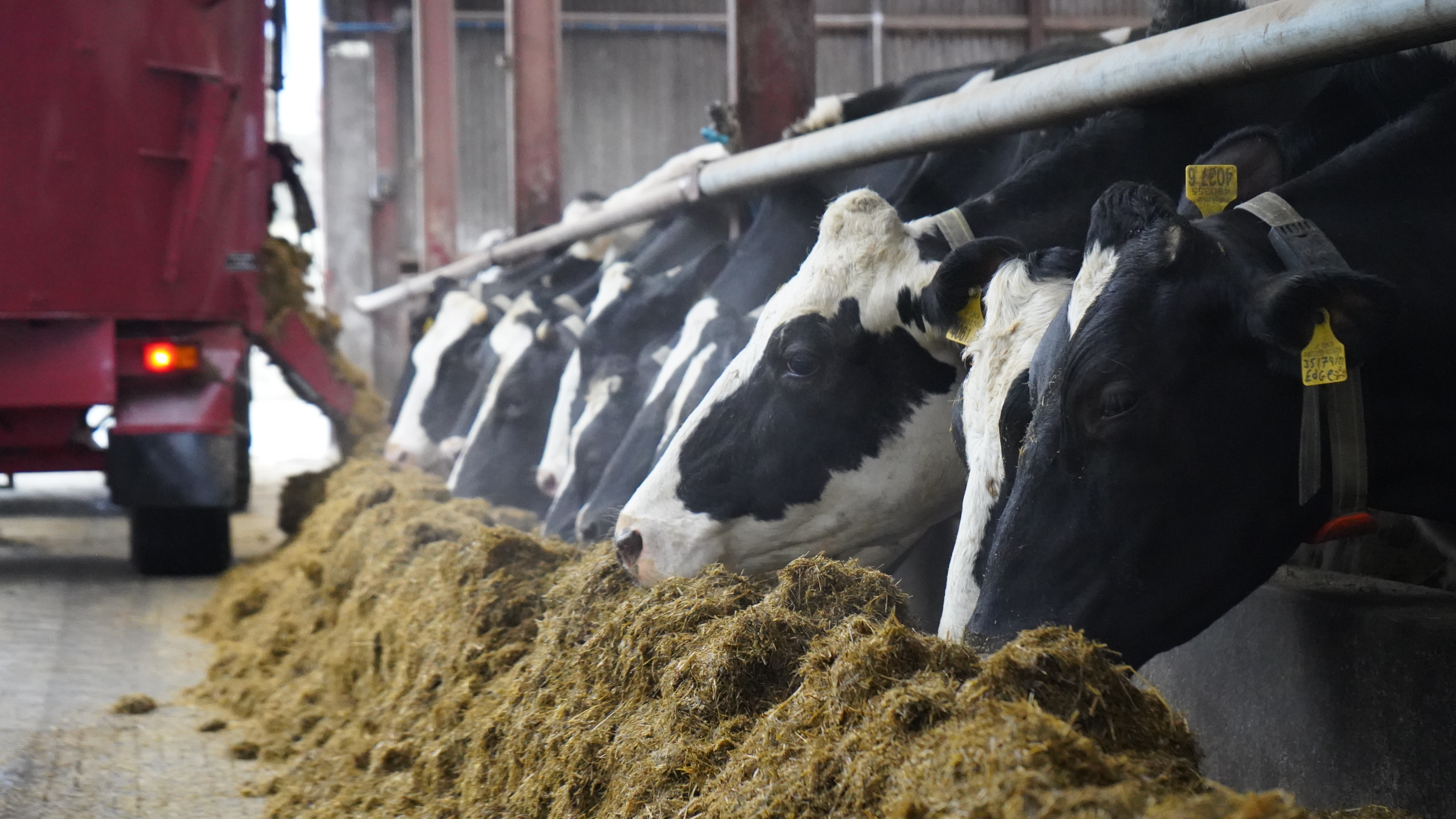
The past year has seen its fair share of challenges for dairy producers, not least when it comes to milk price and cash flow. While there are some signs of positivity on milk price, cash flow looks set to be just as difficult for the winter ahead as rising input costs put a squeeze on margins. As they say “the only way out is through”, and when it comes to managing your dairy herd through this winter, the challenge will be keeping a tight eye on costs but without compromising milk output, milk solids or fertility.
Feed update
Feed costs, alongside most other farm inputs, have risen sharply since the spring. A number of factors are behind this increase, but they are driven mainly by rising energy costs, renewed attacks on shipping in the Black Sea, smaller than expected harvests in the US and drought-hit Europe, and implementation of the EU Deforestation Regulation (EUDR). With no end in sight to the conflicts in Ukraine or the Middle East, costs look set to remain high for the foreseeable future. So when it comes to feeding your cows this winter, targeted and efficient feeding, alongside attention to detail, should be top of the agenda.
Considering the high cost of protein, silages should be analysed regularly to establish if there is scope to feed a lower protein ration. Monitoring milk urea levels, body condition score and dung consistency will also help guide this decision. Feed rate per litre has a greater impact on your feed bill than the cost per ton, so consider if your feed rate is appropriate for the quality of silage and level of milk output currently being achieved. Feed-to-yield systems are now commonplace on many units, which makes targeted feeding of cows easier, but if the feed tables have not been updated or parlour feeders calibrated recently, then you could be over- or underfeeding cows. For herds with a more conventional set-up, grouping or tail-taping should be considered to better target feed the cows that need it most.
The most important cows in the milking herd are the freshly calved and highest yielding cows. It’s important not to underfeed these cows to guarantee good fertility and to ensure cows peak well and yields persist through the lactation. Where possible, high value products like rumen-protected fats should be targeted towards this group, which give the most efficient milk response. With margins tight, it’s also essential to avoid ‘hidden’ costs by focussing on transition cow management, lameness and health.
Forage update
With feed costs rising, the benefits of high-quality forage will be significant this winter. Provisional results from silages analysed by Thompsons so far this year indicate that, on average, first cut silage quality is slightly better than 2025 - 33% dry-matter, 11.2 MJ metabolizable energy, 14.4% crude protein and 46.9% neutral detergent fibre (NDF). Fermentation quality, a key driver of forage intake, is also very good with first cut silages. With the prospect of some very high-quality maize silage to feed alongside first cut silage, there will be opportunities to produce extra milk from forage on some units. The same cannot be said of most second cut silages, with average quality lagging behind last year - 33.7% DM, 10.5 MJ metabolizable energy, 13.8% protein and 48.8% NDF. Cows fed these low energy/high fibre silages will need higher concentrate inputs to maintain milk output, and some will also require additional protein.
On some units, particular in County Down, a large quantity of silage was fed during the summer drought. Recent crops of third and fourth cut have helped to replenish stocks, but producers should assess silage stocks now and source additional forage or alternative feeds as soon as possible, to avoid making abrupt dietary changes during peak milk production. Calculating forage requirements for your herd can be done simply using the Thompsons’ online calculator at www.thompson.co.uk
THE THOMPSONS RANGE
In light of the challenges facing milk producers this winter, Thompsons have developed a range of highly glucogenic winter dairy rations, ranging from 15 to 20% protein, designed to support efficient milk production and quality components from a range of silage types. With high levels of starch across the range, combined with rumen-protected fat in selected rations, the Thompsons’ Winter Dairy Range delivers superior levels of energy from every kilo, maximizing milk output, milk solids and fertility – the key economic drivers on every dairy unit.
Silage quality will be a challenge on many units this winter, particularly when second cuts are introduced to the ration. The Thompsons Winter Dairy Range includes several higher protein options to help balance silages low in energy and protein, and to help stimulate rumen fermentation and dry-matter intake.
For those running a multi-cut silage system, the Thompson Winter Dairy Range features an extended range of high-digestible fibre (HDF) rations, based on maize, sugarbeet and soya hulls, to help support milk solids and rumen function in cows fed very leafy, high quality silage. These HDF rations are also the perfect partner for feeding alongside wet, acidic silages where high levels of lactic acid pose a challenge to rumen health.
Rumen health, fertility, lameness and udder health are the foundation of a healthy and profitable herd. The selection of performance-enhancing tools available within the Thompsons Winter Dairy Range also includes the next generation trace mineral package, Availa ZS, from Zinpro. Proven to enhance fertility, lameness control and udder health, Availa ZS helps ensure your cows are not just fed for this winter, but remain part of the herd for the long term.
Posted 05,10,26 by allison.
Back to NewsPosted 05,10,26 by allison.
Posted 26,03,26 by allison.
Posted 23,02,26 by allison.
Posted 19,02,26 by allison.
Posted 05,02,26 by allison.